

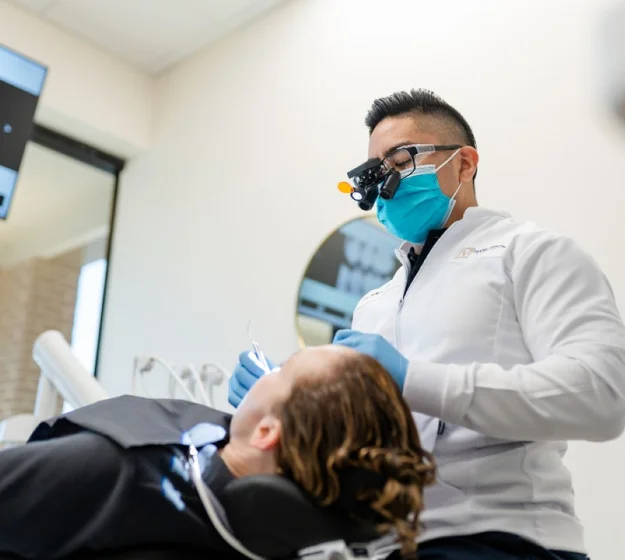
Restore Cracked Teeth with Expert Care
Are you suffering from a damaged tooth that’s diminishing your confidence or causing discomfort? Let our dentist in Charlotte, NC, take a crack at fixing it! Dr. Kyle Viloria of V Dental Health & Aesthetics is well-versed in repairing dental cracks and offers expert treatment for patients of all ages.
Whether you have a cracked front tooth or a fractured molar, our team will prioritize your oral health with the best possible treatment for your tooth injury.
Visit & VibeDental Cracks Defined
Dental cracks, or cracked tooth syndrome, refer to fractures that occur on the teeth’s surface. This condition encompasses a range of fractures, from minor chips on the enamel to deep splits affecting the tooth’s core. Identifying a cracked tooth can be tricky, as the symptoms often vary. You might experience anything from pain when biting to sensitivity toward different temperatures or sweet foods.
The causes of hairline cracks in teeth are diverse, often involving habits like bruxism (teeth grinding), which places undue stress on teeth. Even something as simple as a rapid change in mouth temperature—like enjoying a hot coffee immediately followed by an ice-cold drink—can cause cracks. Nevertheless, through regular dental checkups with the V Dental Health & Aesthetics team, you can minimize the risks and keep your smile safe and sound.
Our Cracked Tooth Repair Process
A cracked tooth can range from a minor enamel fracture to damage involving deeper layers of the tooth. At V Dental Health & Aesthetics, treatment is based on the location and severity of the crack, helping protect your tooth and oral health.
Types of Dental Cracks
Our North Charlotte family dentist encounters a wide variety of cracked teeth. Typically, you can categorize these cracked teeth into one of the following five types:
- Craze Lines: These mild tooth cracks are tiny, superficial hairline fractures in the enamel that appear as a faint vertical line.
- Fractured Cusps: Typically occurring in teeth with large fillings, this type of crack forms when a piece of the chewing surface breaks off.
- Cracked Teeth: A fracture that extends vertically towards the root is a sign of a cracked tooth.
- Split Teeth: A split tooth, or a crack that runs deep enough to divide the tooth, occurs when you ignore a cracked tooth for too long.
- Vertical Root Fractures: This type of dental crack starts at the root and moves upward, often showing minimal symptoms.
V Stands for Vibrant
Don’t let your oral health slip through the cracks! At V Dental Health & Aesthetics, patients can count on Dr. Viloria for:
- Calming Nerves with Proven Strategies. Your Comfort Is Our Promise.
- Trusted by Families for Expert, Personalized Dental Care
- Friendly, Compassionate Care, Every Step of the Way
Frequently Asked Questions About Cracked Tooth Repair
A cracked tooth can result from biting down on hard foods or objects, teeth grinding, dental trauma, large fillings, or normal wear over time. The risk can also vary depending on the location, condition, and strength of the affected tooth.
Common signs may include pain when biting or chewing, sensitivity to hot or cold foods and drinks, discomfort that comes and goes, or swelling around the affected tooth. Some cracks may cause few noticeable symptoms, making a dental evaluation important.
Unlike bones, teeth cannot naturally repair a crack once the tooth structure has been damaged. Treatment depends on the type and severity of the fracture and may include dental bonding, a filling, or root canal treatment in more extensive cases.
A filling may be an option when the crack is superficial and limited to the enamel or when there is associated tooth damage that can be restored with a filling. The dentist will evaluate the tooth to determine the appropriate treatment.
No. A root canal is not necessary for every cracked tooth. It may be recommended when a fracture extends into the pulp or causes damage to the inner portion of the tooth. Minor cracks may require less extensive restorative treatment.
The dentist will examine the affected tooth and evaluate your symptoms, bite, and the location of the suspected fracture. Additional diagnostic methods may be used when needed to better understand the extent of the damage and determine appropriate treatment.
A crack can potentially become more extensive over time, particularly when the tooth continues to experience pressure from chewing or grinding. Delaying an evaluation may make the tooth more difficult to restore, depending on how the fracture progresses.
Many cracked front teeth can be treated depending on the location and severity of the damage. Options may include dental bonding, a filling, or another restorative treatment. The dentist can recommend an approach based on the condition and appearance of the tooth.